
Environmental Justice Index
Advancing Health Equity Through Data
The Environmental Justice Index (EJI), developed by CDC/ATSDR in partnership with the U.S. Department of Health and Human Services, is the first national, place-based tool designed to measure the cumulative impacts of environmental burden through the lens of human health and health equity.
Achieving health equity requires focused and ongoing societal efforts to address historical and current injustices. To this day, people of color, low-income, marginalized, and Indigenous peoples are disproportionately burdened by multiple environmental hazards in the places where they live and work. The effects of environmental burdens on health can be compounded by pre-existing health conditions and social inequities, creating a cumulative impact that hinders optimal health and environmental justice for these populations.

Understanding Cumulative Environmental Impacts on Our Health
Cumulative impacts are the total harm to human health that occurs from the combination of environmental burden, pre-existing health conditions, and social factors. Cumulative impacts can result from long-term exposures to environmental pollution and community stress such as noise pollution, odor pollution, loss of natural resources, or lack of access to quality healthcare or other resources. These factors have long-term effects on health and well-being. Degraded environmental conditions within a community can lead to economic disinvestment perpetuating generational economic and health inequities for residents.
Calculating the Environmental Impact on Communities
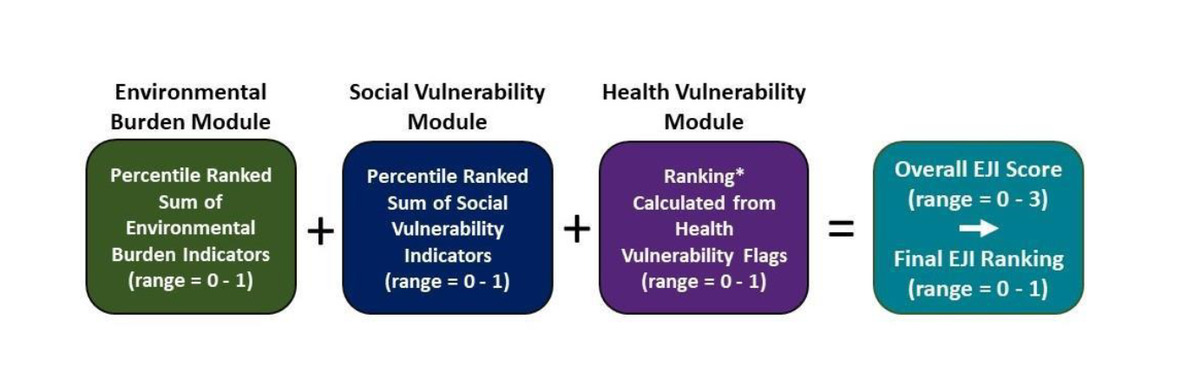
The EJI uses data from the U.S. Census Bureau, the U.S. Environmental Protection Agency (EPA), the U.S. Mine Safety and Health Administration, and CDC to determine the impact of environmental factors for more than 71,000 U.S. census tracts. The EJI ranks each tract on 36 environmental, social, and health factors and groups them into three overarching modules and ten different domains. The overall EJI score is calculated by summing the ranked scores of the three modules: the Environmental Burden Modules, the Social Vulnerability Modules, and the Health Vulnerability Module. Each module represents an important aspect of cumulative impacts.
Explore the Environmental Impact of Your Neighborhood using CDC's Environmental Justice Index
Using the link above or the tile below, you can explore CDC's interactive Environmental Justice Index map. This interactive demonstrates how the EJI can be used to advance environmental justice and health equity through data visualization. It also features case studies of communities that have faced environmental injustice, including Warren County, North Carolina, which sparked the environmental justice movement in the 1980s, and water crises in Flint, Michigan, the San Joaquin Valley in California, and Jackson, Mississippi.
 |